
FRIEZE LONDON
CORINNA GOSMARO, GUILLAUME LINARD OSORIO, RACHEL MICA WEISS
OCTOBER 14-18, 2026
BOOTH B20, LONDON, UK
CARVALHO makes its FRIEZE London debut with gallery artists Rachel Mica Weiss and Guillaume Linard Osorio, and introduces Corinna Gosmaro to the gallery's program. The last century has shown what might emerge when figurative representation recedes and fidelity to literal visual description ceases to be privileged: an abstract visuality enamoured with pure contact, presentness, vibrancy and simultaneity. Weiss, Osorio and Gosmaro belong to this tradition, and extend its quest for alternative forms of attention and meaning making, suggesting the primacy of touch as a sensory mode, the immediacy and multiplicity of perceptual data it conveys, though each artist proposes distinct phenomenological riffs on this modality.
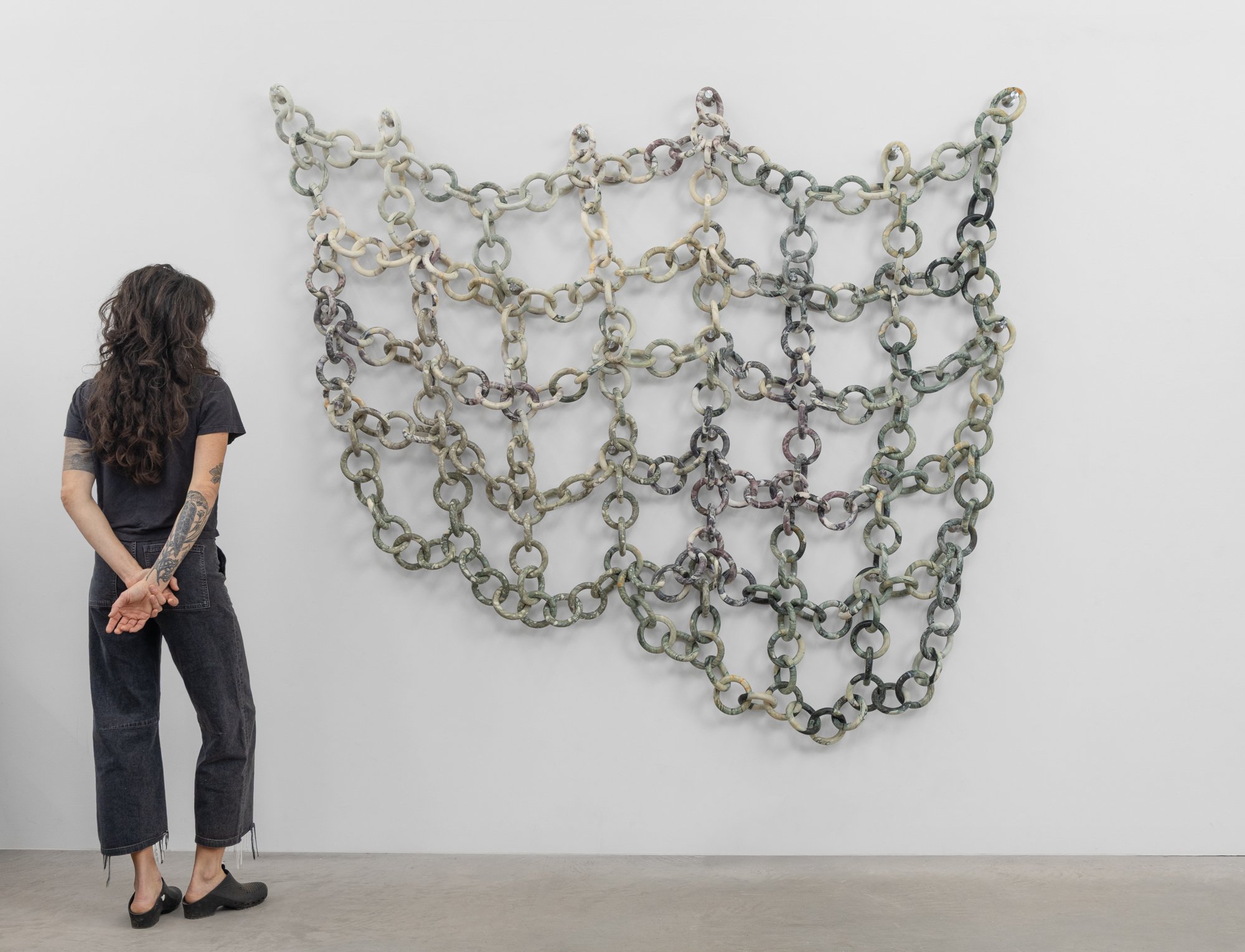
For Weiss, whether in her hand-carved marble sculptures resembling oversized jewellery or in her tautly threaded woven screens, the preoccupation is pressure, weight and tension, which are manipulated through distortions of scale and unexpected choices of materials. How We Held It Together (2026) is formed of chain links and padlocks strung together like a necklace but is the size of a wrought iron gate, and so much heavier it’s hard to imagine it being lifted, let alone worn. How We Held It Together has the appearance of an adornment—something culture defines as trivial, decorative—but also has a charged totemic presence, as though it were a statue of a mystery deity. Both sculptures are characterised by this plenitude of possible senses and latent energies. Net (2026), comprised of circular links with echoes of chain mail, fishnet and drapery—different connotations that coexist, and feed the sculpture’s ambiguity—also uses weight, solidity and density to give form to a constellation of ambivalent affects. What bodies forth: burden, effort, entrapment, intricacy, control and difficulty. A preference for touch is not, in other words, equated (as it typically is) with softness or tenderness, a binary which frames sight as the dominant sense capable of extracting ‘hard’ data from its surroundings.
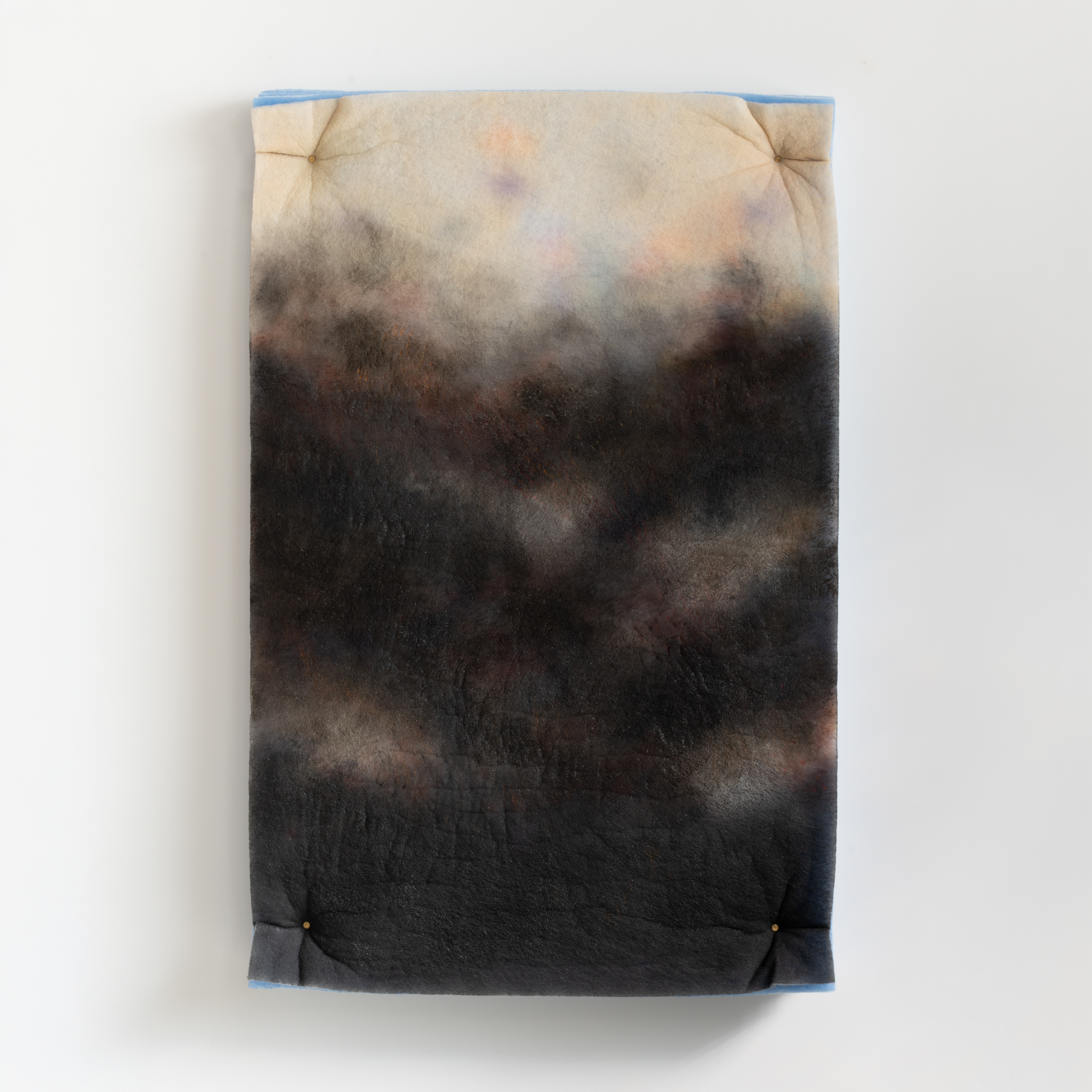
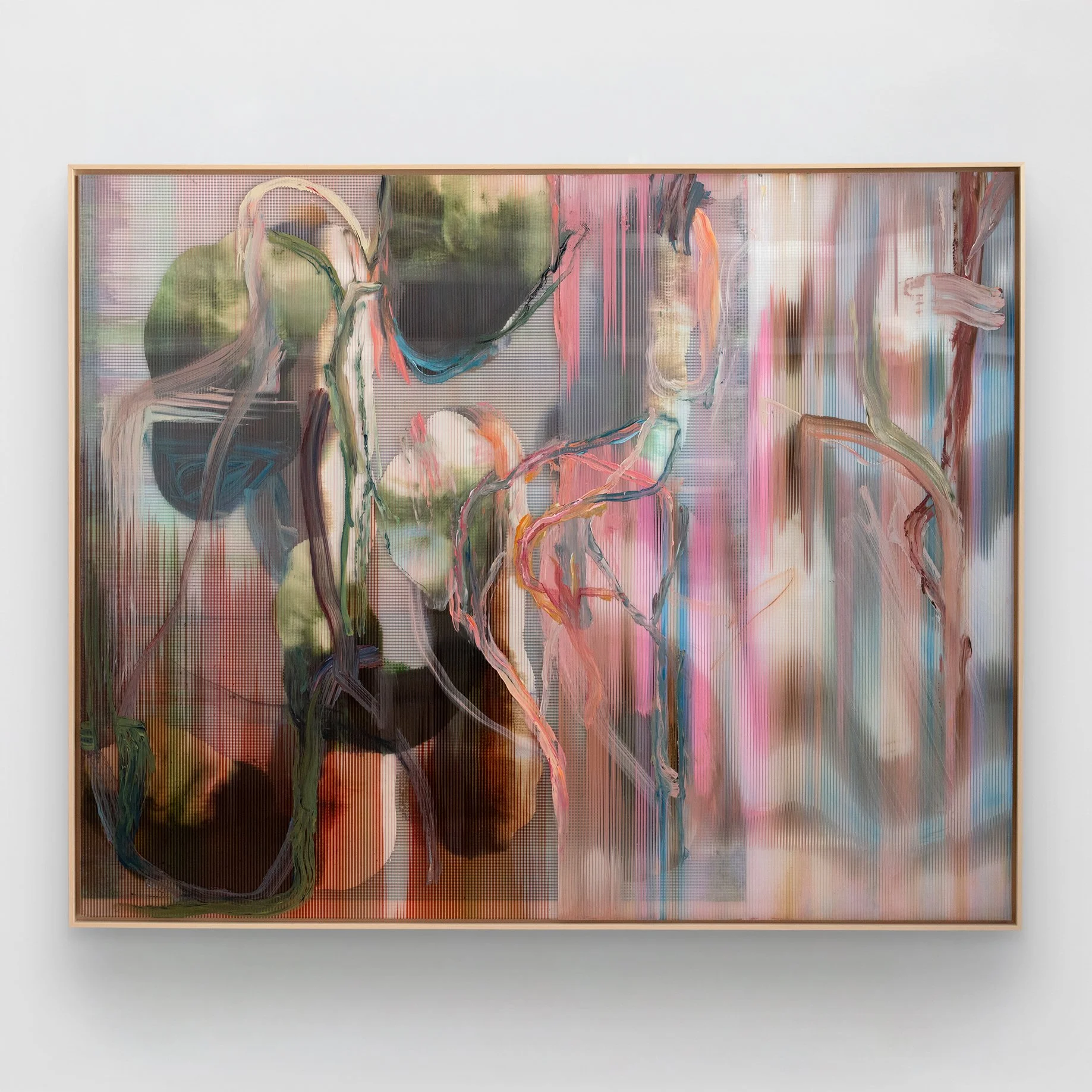
Gosmaro, who paints into polyester fibres, is similarly interested in how touch might convey metaphorically certain intensities of somatic experience. Colour has a visceral resonance that suggests possible visual correlatives for physiological events: chemical transmissions, circulation, shifts in temperature, processes human animals share with plants, a likeness and interconnectedness with ethical implications. Traditional landscape painting equates sight with mastery. Though the layers of rectangular polyester take after the dimensions of easel painting, Gosmaro otherwise upends the genre’s representational strategies: hierarchies of figure and ground are dissolved; the pieces protrude off and flow from the walls. Osorio also explores the possibilities afforded by haptic visuality. Osorio’s medium, a polycarbonate with a cellular structure, produces a grid that gives his paintings a dynamism, a sense of vibration and movement, and a confounded sense of depth and shallowness that enlivens the spectator’s proprioception. Between the support of the canvas and its surface lies a region rarely explored by artists. Normally, this would be a vanishingly small territory—a shred of fabric. Osorio, however, has created an interior space within the canvas into which paints are funnelled. This produces a three dimensionality that breaks with easel painting’s illusory strategies, and together with experiments in mark-making, volume and space, Osorio folds the sensuous knowledge of touch into sight’s paradigm. Sight and touch are intertwined, and across all three artists’ work, perhaps this isn’t just for the purposes of greater intimacy and immersion: dualist thinking and anthropocentrism recede; a posthumanist aesthetic slides into view.
The paintings in Osorio’s series are individually numbered and collectively titled Hypothetical Landscape, and broadly their semblance is to forms of experience (psychic, somatic, visual, emotional) rather than to nameable objects. Nevertheless, intimations of the natural world push through. Wending lines and efflorescent forms mimic the appearance of flowers and foliage. Gosmaro’s biomorphic forms share this economical and allusive quality. Gosamaro’s immersive landscapes contain incidental, subtle references to objects from nature: the spray of paint occasions glimpses of soil, rhizomes, fog, algae, dense foliage. Weiss’s fibre works, a matrix of threads woven onto a wooden support, resemble skies troubled by weather, sunlight and shadow, or they shimmer with a mysterious intensity like portals into another world. Abstraction for these artists has a liveliness, a vitality, gives rise to an abundance of polysemous imagery. Another consequence of this abstract and abstracting vision is a heightened sensitivity to colour. In Net, the smooth finish of the marble accentuates the coruscating palette of dark neutrals, gradations that are further enhanced by the stark, repetitive form the marble assumes. Exaggerated, saturated tones in Osorio and Gosmaro’s work are imaginative flights into the chromatic potential of ordinary phenomenon and diverse organisms. Osorio, Weiss and Gosmaro each assemble environments that are enriched by intimations of meteorological details—heat, pressure, radiation—that sight alone couldn’t depict, appreciate or explain. These works are kindling for our sensorial pleasures, blueprints for embodied looking.
Essay by Rebecca Birrell, PhD
FRIEZE London is CARVALHO’s debut at the fair’s London edition. Previous presentations include FRIEZE Seoul (2025) and Los Angeles (2026), as well as a 2024 exhibition at FRIEZE No. 9 Cork St.