





HERON
WINTER PERFORMANCE SERIES 2026
A NEW CHOREOGRAPHIC WORK BY ETAY AXELROAD, SET AMONG A SITE-RESPONSIVE INSTALLATION BY GUILLAUME LINARD OSORIO
OPENING PERFORMANCE THURSDAY, JANUARY 29, 7:30PM
FRIDAY, FEBRUARY 6, 7PM
THURSDAY, FEBRUARY 12, 7PM
WEDNESDAY, FEBRUARY 18, 7PM
FRIDAY, MARCH 6, 7PM
WEDNESDAY, MARCH 11, 7PM
CLOSING PERFORMANCE + ARTIST RECEPTION, SATURDAY, MARCH 14, 6PM
INSTALLATION ON VIEW JANUARY 30, 2026 — MARCH 14, 2026
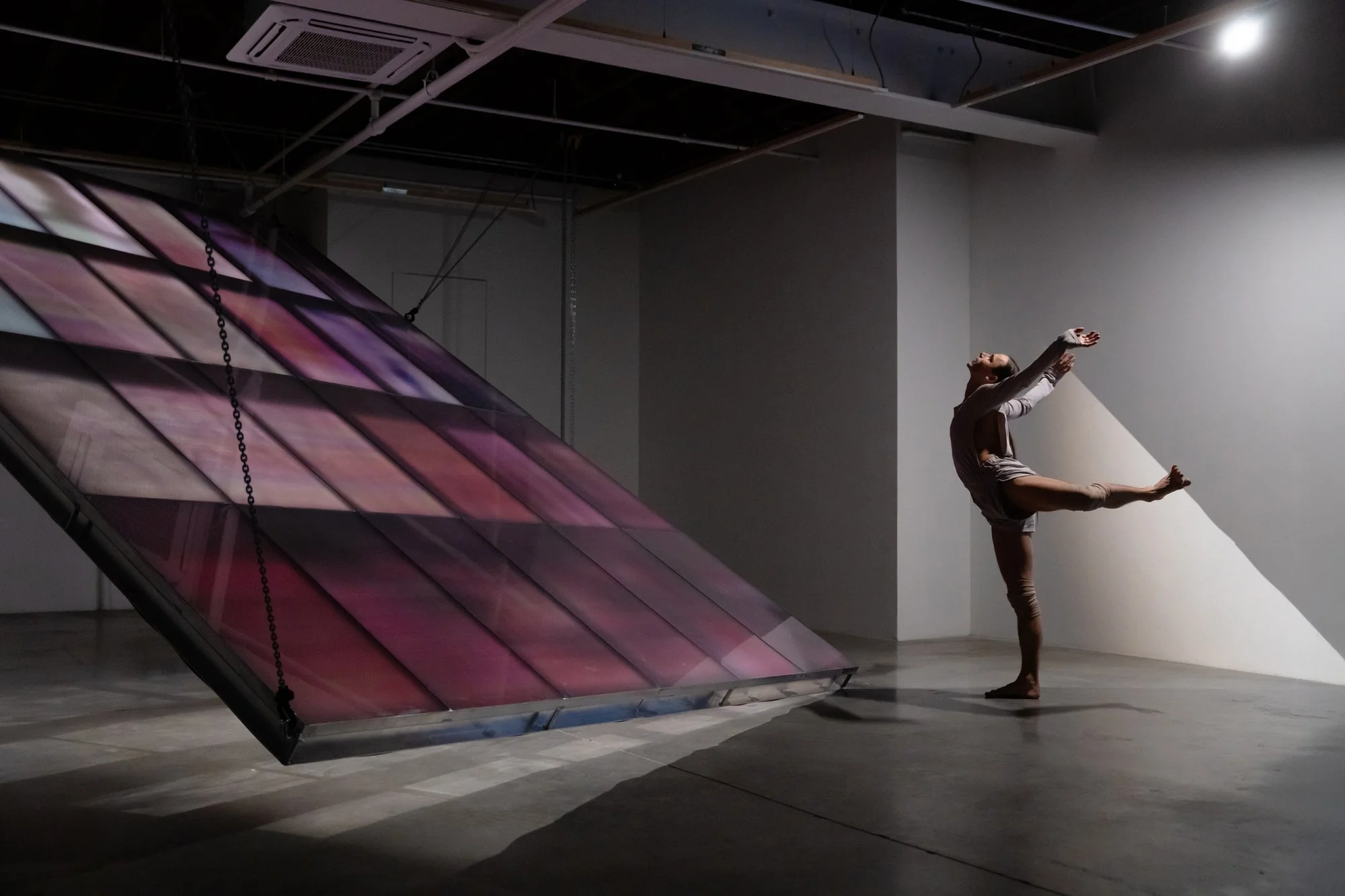
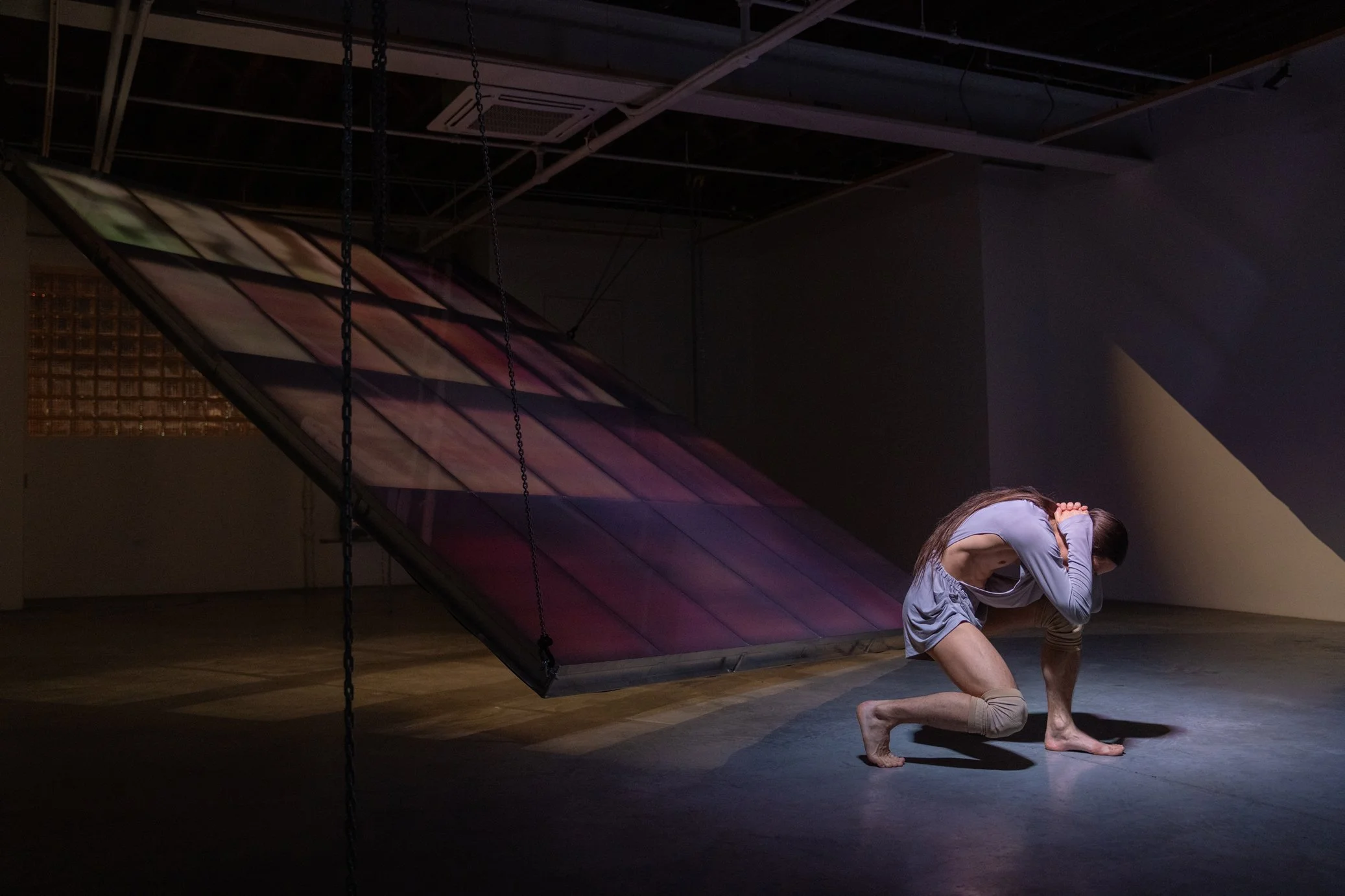
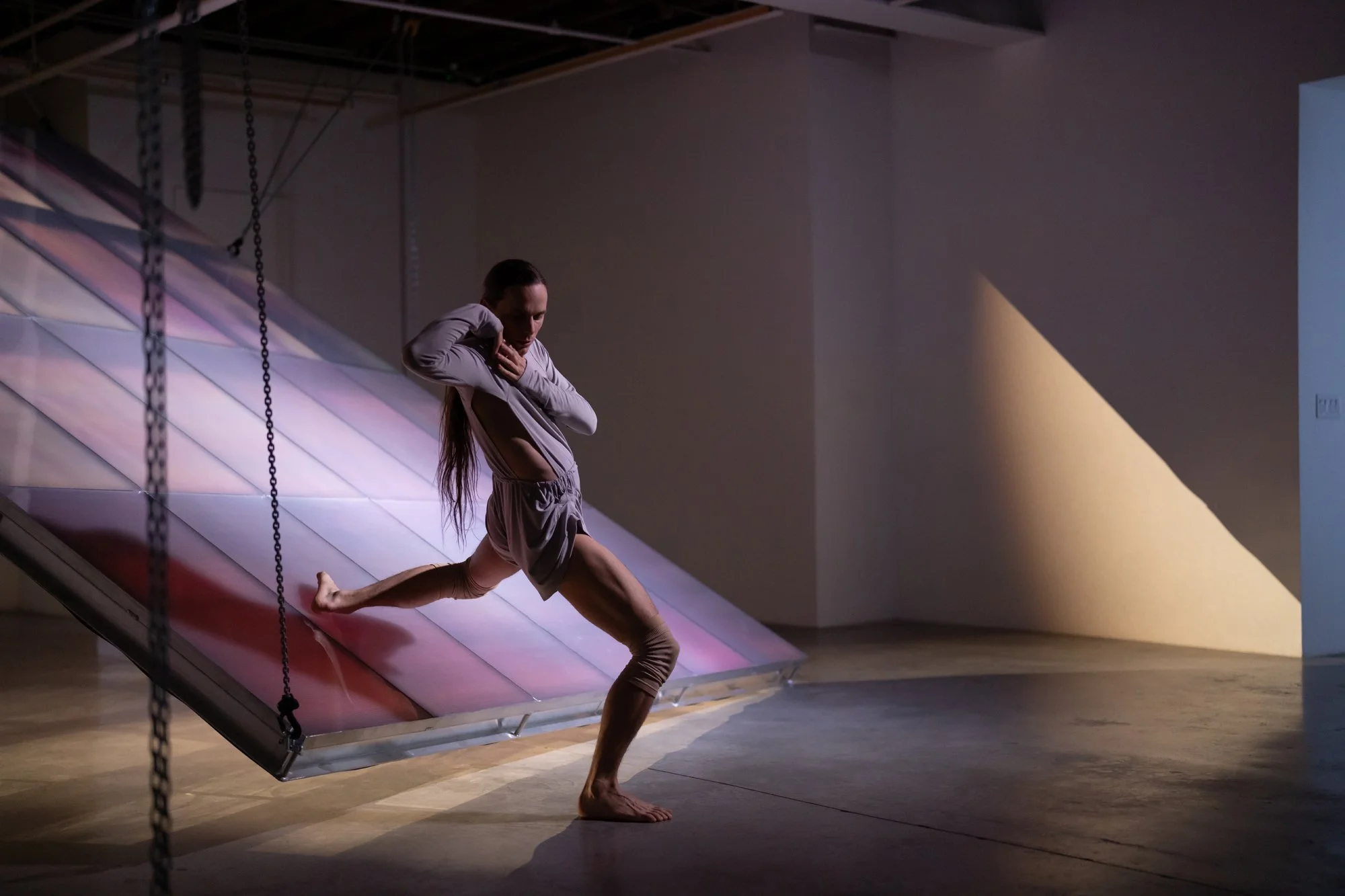
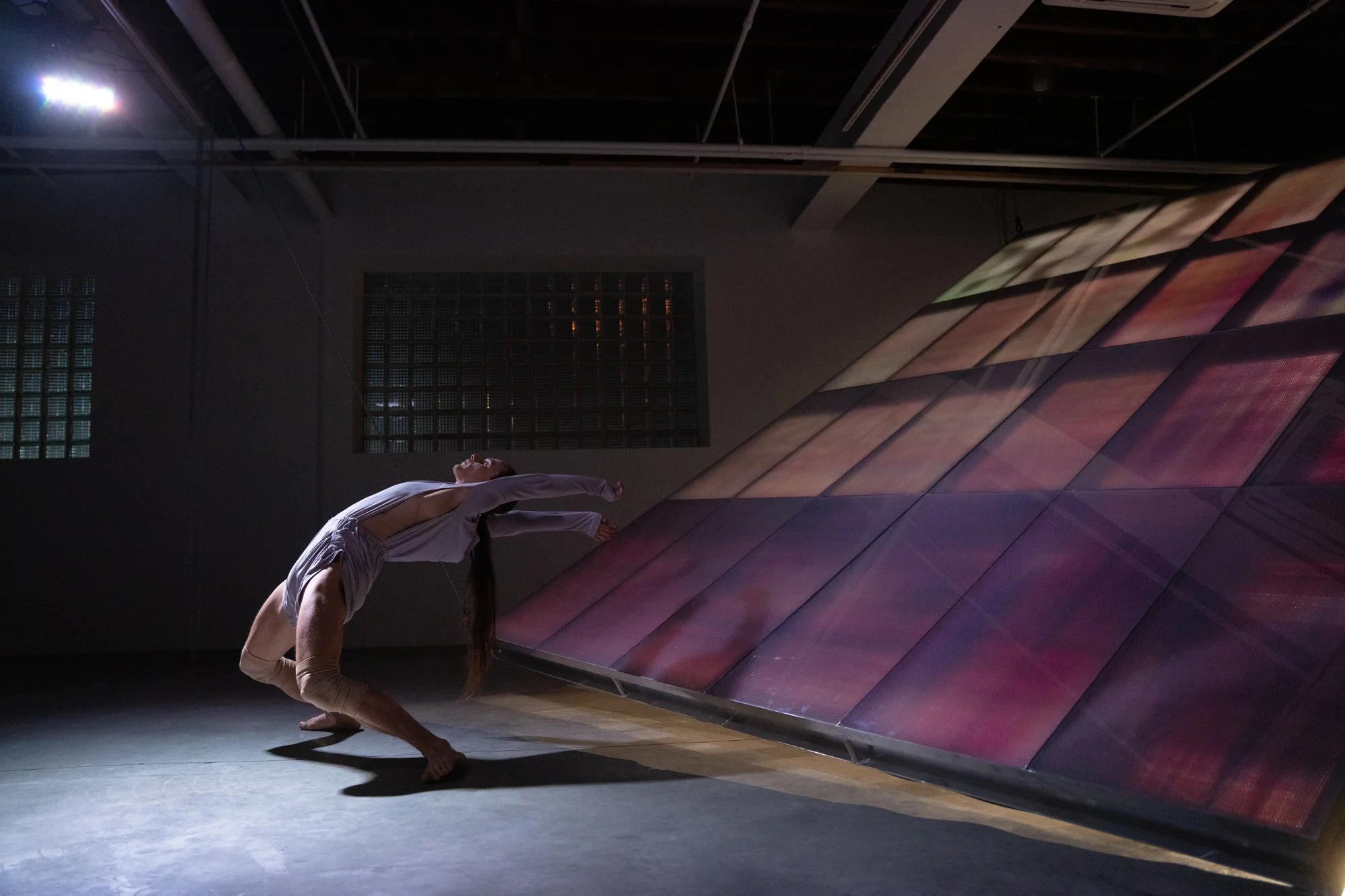
CARVALHO announces the fourth edition of its acclaimed performance series, positioning a collaboration with Paris-based artist, Guillaume Linard Osorio, and Israeli choreographer and contemporary dancer, Etay Axelroad. Linard Osorio’s commissioned, site-responsive installation imposes a charged scene for Axelroad’s latest choreography, Heron, opening Thursday, January 29, from 6–9pm, with a performance at 7:30pm. Following the premiere, the collaboration extends across a series of performances on February 6, 12, and 18, and March 6 and 11, culminating in its final iteration on Saturday, March 14, at CARVALHO’s 110 Waterbury St. space.
At the quantum level, matter is no longer solid. It is mostly empty space, held in place by invisible forces and constraints. Our perceived reality persists because form emerges from dynamics; the ephemerality of the flower and the permanence of the pyramids both spring from the same field of relations, not opposites but bound by differing scales and lifespans.
Here the synthesis between sculptor and choreographer—sculpture and dancer—mirrors the laws of the quantum field. The charged space between them induces a third, unfixed entity, making the empty space within the work as necessary as atomic emptiness. Each practice retains its integrity, its own language, and yet meaning arises through their mutual influence and resistance: the transient and the fixed briefly merge, imprinting upon one another.
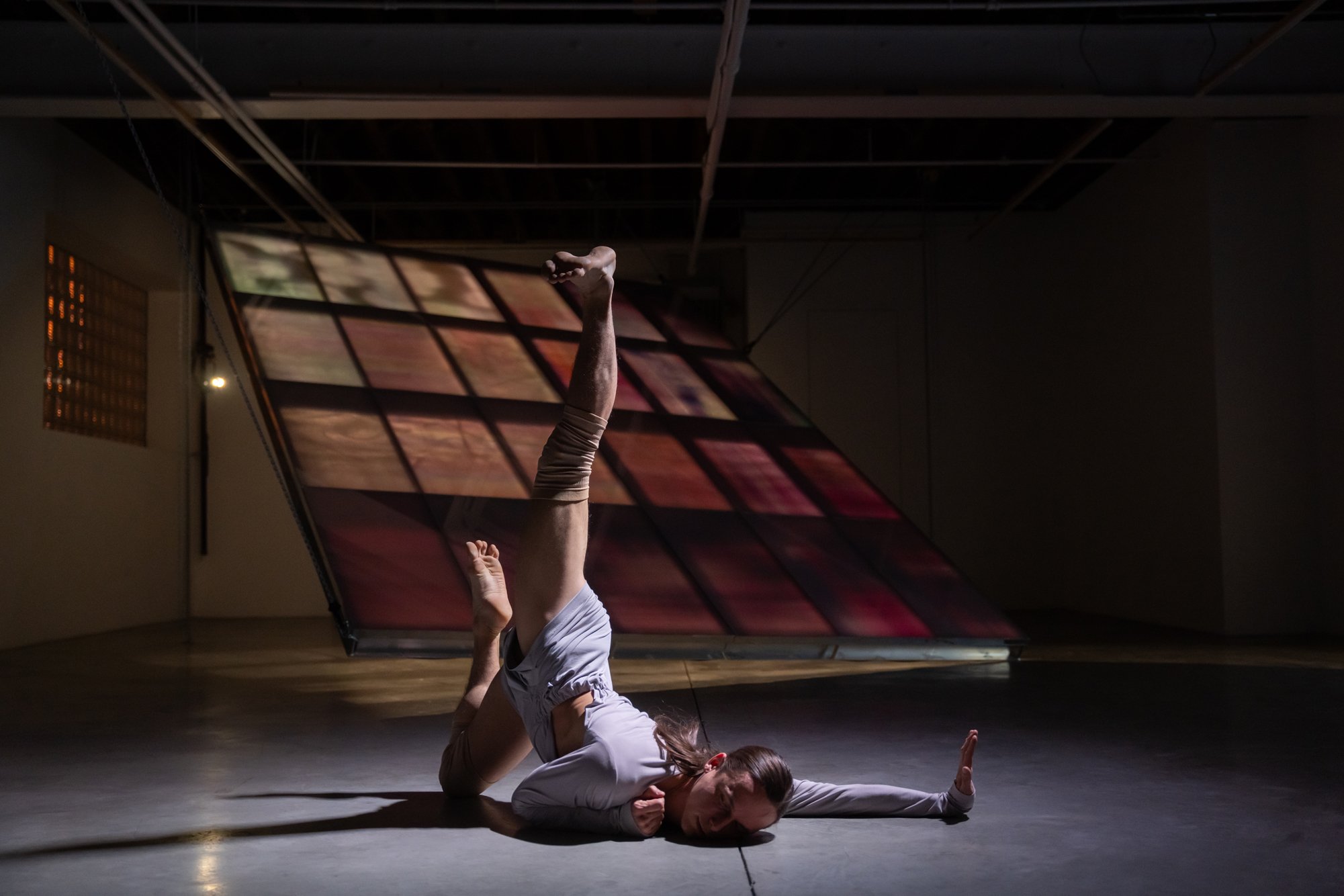
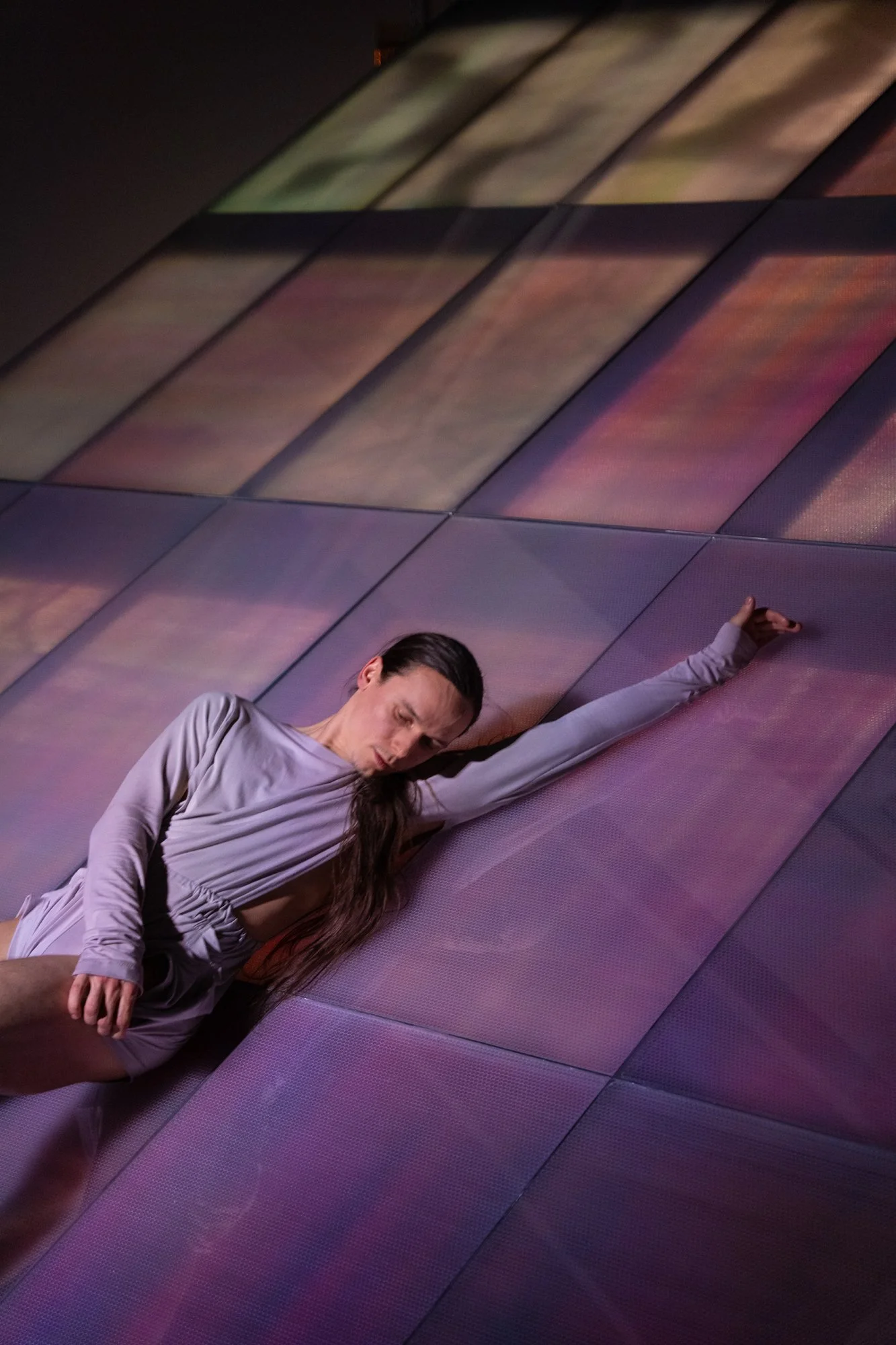
Central to the collaboration is a shared inquiry into the thresholds of perception: a painting emanates into space, a body is extended by static material, movement lingers even when motion ceases. Light pours through polycarbonate surfaces, carrying the painted image beyond its assigned plot in the frame. The project unfolds as both performance and installation—an encounter between body, structure, light and movement. What emerges is a work that resists disciplinary boundaries, less a stage than a perceptual continuum.
Linard Osorio’s practice is rooted in architectural logic and physics. He uses polycarbonate, a material used for skylights, façades, greenhouses—spaces where form partners with illumination. In both his paintings and sculpture, polycarbonate is the canvas, though not a passive one. Paint is injected, manipulated through interior spaces, and allowed to travel according to the internal logic of the material itself. The result hovers between painting, stained glass, and the ominous glow of a digital screen, forming images that feel technological despite their handmade origins. Through the study of contemporary dance, Linard Osorio has undergone a tectonic shift in his practice, experiencing the body as an expressive instrument rather than a controlling one. Just as an architect considers ground, walls, and sky, the empty space between elements implicitly becomes a stage for the body. Movement entered his thinking and, therefore, his work.
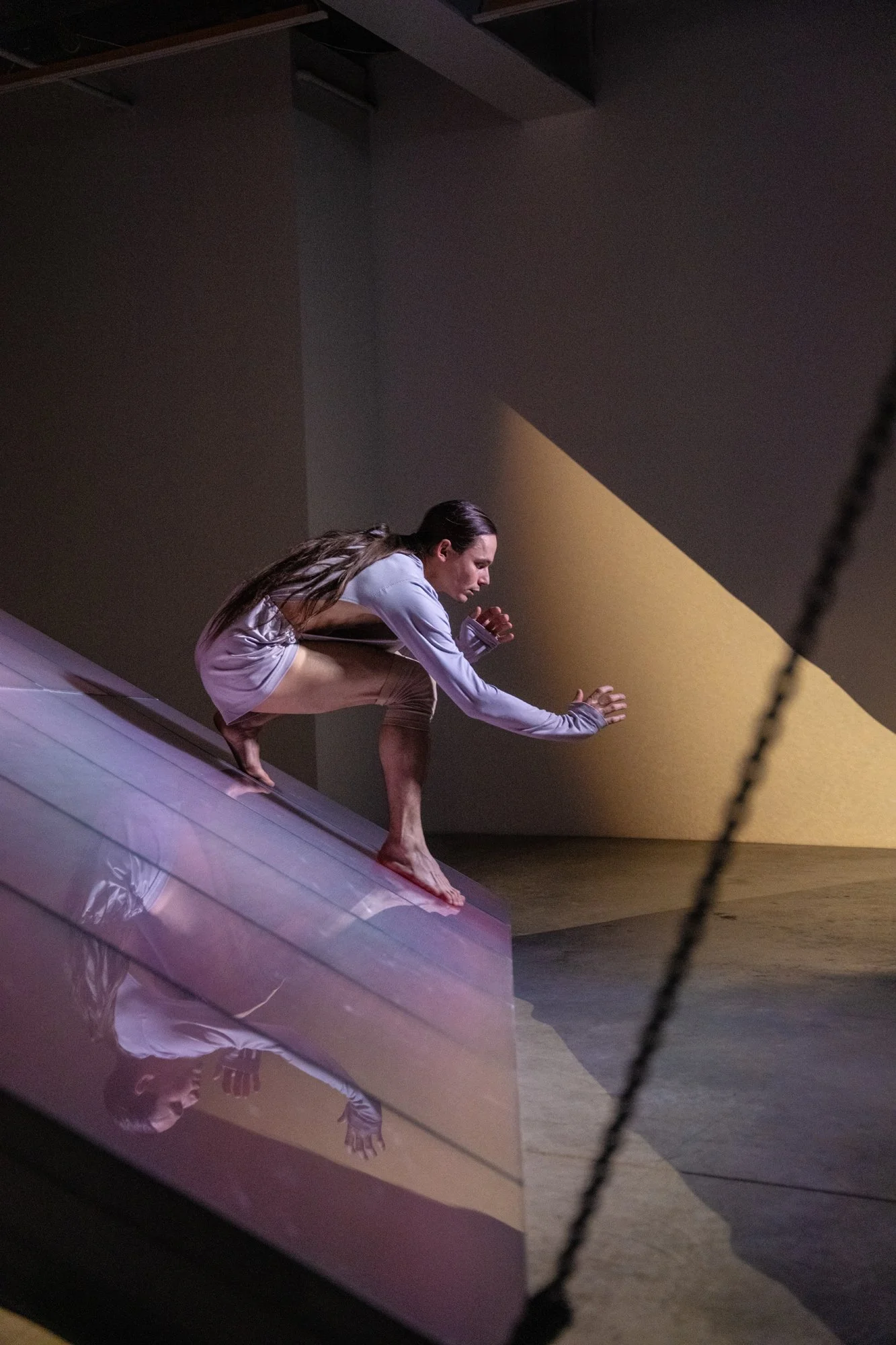
Axelroad’s practice brings a complementary intelligence to the interchange. Trained in ballet and contemporary dance and shaped by Ohad Naharin’s Gaga technique—a dance style that is more experiential than technical, in which the dancer, in a distillation of intent, is asked to present purely what exists inside of him rather than inputting external, technical vocabulary. Likewise, Axelroad’s movement prioritizes sensation, responsiveness, and presence over fixed form. He moves with a jointless, liquid quality—strength encased in delicacy. His body reads space attentively, responding not only to gravity and structure but to light itself.
The disciplines create a hybrid form in which body and material negotiate space and luminosity together. The work also stages an unspoken tension between qualities often coded as oppositional: the defined, assertive geometry of metal and structure, alongside the softness, receptivity, and expansiveness of light and movement.
Linard Osorio’s sculptural 200 sq-ft, multi-paned installation is conceived in direct response to Axelroad’s physical needs as a dancer. The sculpture, permeated by beams of light and suspended by weeping chains, stands as the dancer’s opposite and complement. Gargantuan by comparison, it acts simultaneously as partner, stage, and womb, containing the illusion of permanence that allows the dancer’s transient presence to take form.
Axelroad’s movement alters the atmosphere, creating an aura that expands far beyond the parameters of the body, enveloping the installation, scaling it, surrendering to it and giving its presence layered meaning. He responds to illumination as both stimulus and constraint, feeding off light as much as gravity, complicating binaries of masculinity and femininity, force and yield. Both artists ask us to bear witness to where things begin and where they end. Like atoms in the quantum field: the work holds together precisely because it is relational, dynamic, and never fully solid.
Text by Cynthia Dragoni, a New York-based arts and culture writer and producer. Dragoni is the creative director of The Dance Lens, a platform featuring interviews and podcasts at the intersection of the performing arts, culture, and politics.
Performance series are commissioned by CARVALHO, New York, and curated and produced by its founder, Jennifer Carvalho. The biannual series invites both visual and dance artists to reimagine their creative processes. It draws dance out of the theatre and into the collective consciousness, while bringing visual art into the realm of movement and performance—opening possibilities for both forms. Commissioned collaborations between performing and visual artists consider how disciplines are transformed through collaboration, as limitations are eclipsed, creating new intersectional approaches and total, synthesized works.
Performances are free and open to the public, but due to the limited space, an RSVP is required: rsvp@carvalhonewyork.com
Guillaume Linard Osorio – Visual Artist
Etay Axelroad – Choreographer, Performing Artist
Kyle Driggs – Lighting Design
Anna Lann – Original Composition, Sound Design
Erica Johnston – Costume Design
Shaked Werner – Rehearsal Assistant
Jennifer Carvalho – Curator and Producer
Etay Axelroad (b. 1995, Romania) is an international choreographer, dancer, movement director and educator with a focus on live and performance art as essential practices of human connection. He previously worked with Batsheva Dance Company, GöteborgsOperans Danskompani, KOR'SIA, and S-E-D (Sharon Eyal + Gai Bechar). Since 2016, his choreographic works have been staged in Japan, Sweden, Austria, Hungary, Spain, Germany, France, Israel and the United States. Axelroad is the founder of Dip Movement Methodology, which, for the past decade has developed the core foundation of his creations and teachings.
Guillaume Linard Osorio (b. 1978, France) lives and works in Paris. Linard Osorio has two forthcoming institutional exhibitions in France in 2026, at the Grand Salon des Émigrés at the Château d'Oiron in Plaine-et-Vallées, and with the Centre d'art La Chapelle Jeanne d'Arc in Thouars. In 2025, he was invited to present two site-specific installations of his ongoing series Screen as Performance at the Chateau d’Oiron, Plaine-et-Vallées, and the Chapelle de Locmeltro, Guern. Linard Osorio’s work has been shown at the Centre Pompidou (Paris), the MAMCO Museum of Modern and Contemporary Art (Geneva), the Bourges Contemporary Art Biennial (Munich), La Maréchalerie Center d'Art Contemporain (Versailles), and the Biennale Internationale de Design (Saint-Étienne), among others.
Linard Osorio is globally represented by CARVALHO, New York, with whom he’s had three solo exhibitions, including a collaborative installation and performance series with choreographer and contemporary dancer, Etay Axelroad. Linard Osorio is a graduate of the École Boulle and the École Nationale Supérieure d’Architecture Paris-Malaquais. His work is in the permanent collections of Ministry of Europe and Foreign Affairs of the French State and FRAC Bretagne (Régional Fund of Contemporary Art of Brittany, France).
CARVALHO (est. 2019) A synthesis of the Director’s background in performing and visual arts informs a distinct point-of-view that shapes the gallery’s cross-disciplinary program, privileging the sensorial experience of the art object and space. CARVALHO features international emerging and mid-career artists whose practices reconsider distinctions of increasingly fluid categorization – of the visual art, performing art, and craft realms – through dedicated inquiry and meticulous approaches to material and process. Exhibitions work to activate the viewer’s environment, expanding space for engagement and discourse between disciplines. At the close of 2023, on the cusp of its five-year anniversary, CARVALHO expanded its galleries into the adjacent building, doubling its exhibition space and program. The second gallery focuses on installation and performance, echoing the Director’s foundations, and allowing artists to realize more ambitious collaborations and projects.
For press inquiries, please contact Elisa Smilovitz at elisa@elisasmilovitz.com