
NASCENT BODIES
GABRIELE BEVERIDGE + MAXIMILIAN RÖDEL
OPENING 11.06.26, 6 – 9PM
ON VIEW 11.07.26 – 01.09.27
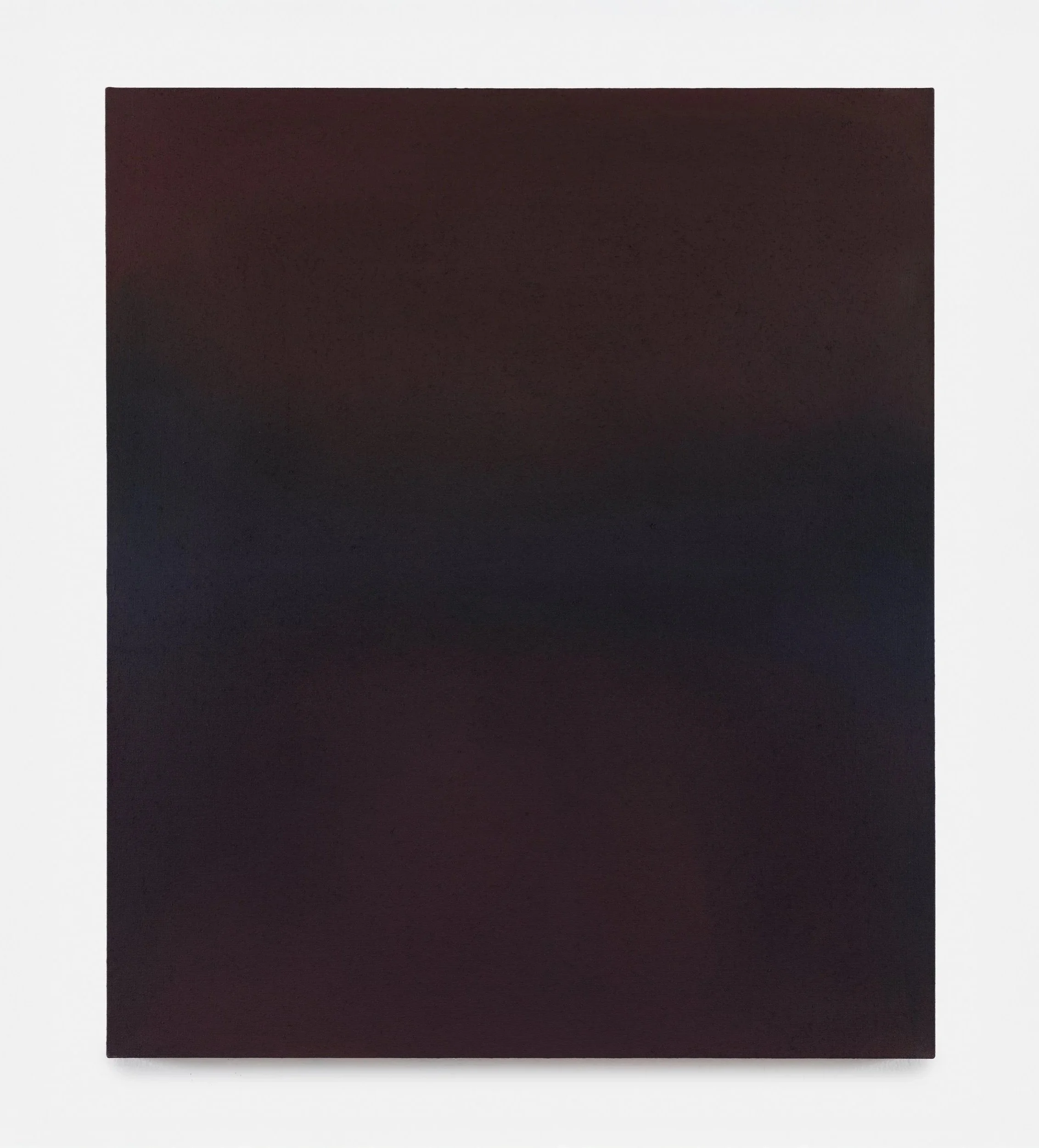
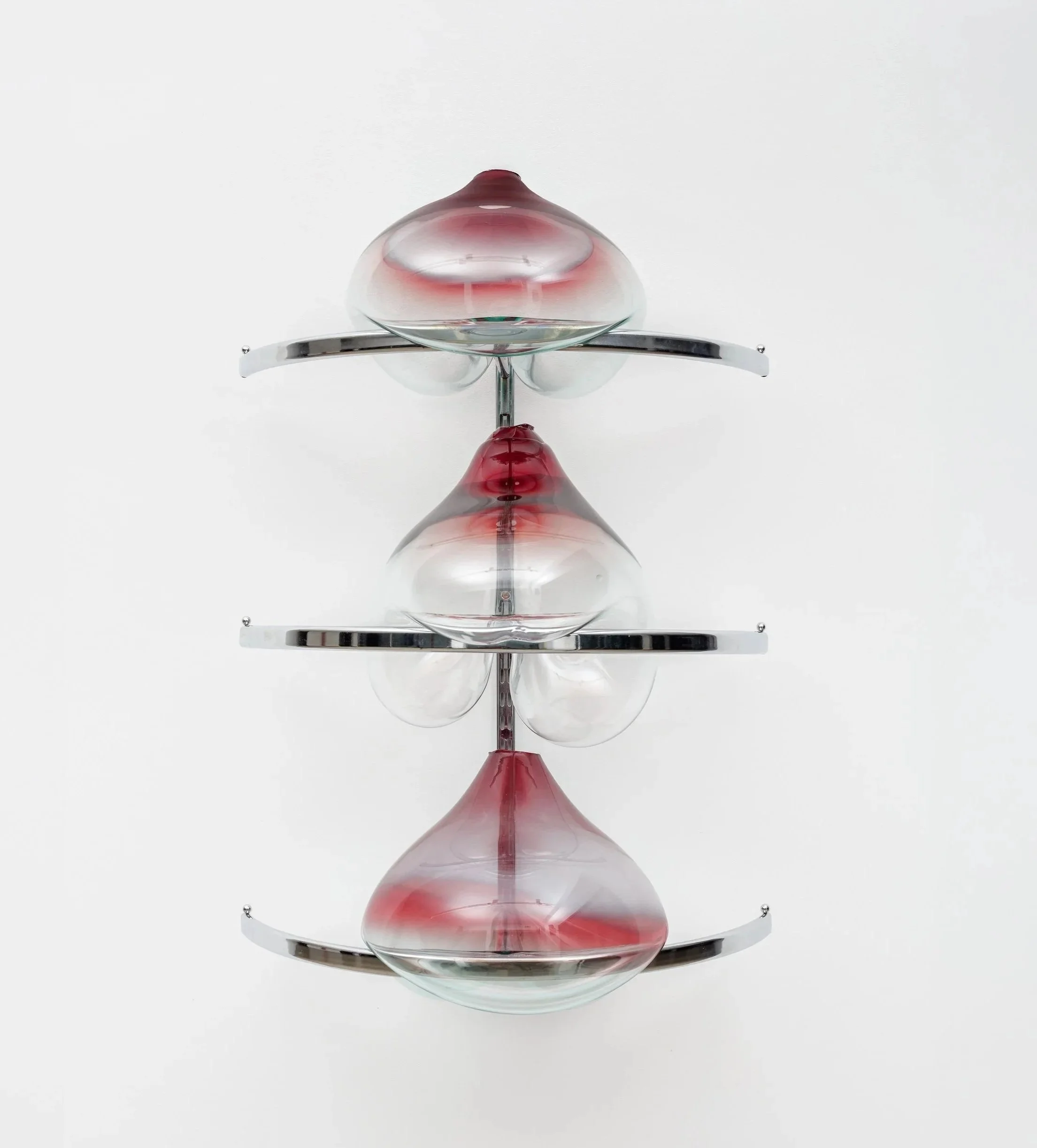
The sublime is transitional, transformational, a radically reordering variety of aesthetic experience. It can arise from an encounter with something vast and seemingly beyond comprehension, but equally from a sudden awareness of the strangeness and vulnerability of our own bodies. In the paintings of Maximilian Rödel and sculptures of Gabriele Beveridge, these distinct experiences of the sublime find expression through radically different material and perceptual means. Rödel's luminous, atmospheric paintings suggest expanses beyond the limits of human perception, while Beveridge's delicately wrought glass sculptures bring us into uncomfortable proximity with the fragility and mutability of life. Both practices heighten our awareness of the body as the instrument through which we encounter and attempt to comprehend the world. The sublime has the power, as Anne Carson writes—in her essay on the classical scholar Longinus—to ‘echo from soul to soul.’
The most obvious etymological root of the term is the Latin sublimis, meaning elevated: the heavens are up there in this above, connoting celestial goodness and power. Perhaps the most enduring apprehension of the sublime is this mysterious sensation of spiritual intelligence. Rödel's paintings—in their scale, radiance and meditative stillness—elicit a heightened form of absorption, a sensation of connection akin to that sought in divine experience. Yet their chromatic intensity and depth are also profoundly physical. Subtle gradations of color seem to gather and disperse across their surfaces, producing an almost atmospheric density that resists any fixed sense of space or distance. The eye moves between areas of saturation and dissolution, as though attempting to apprehend something that remains perpetually beyond its reach.
In the Middle Ages, the adjective was modified into sublimare, a verb that entered common usage amongst alchemists to describe the transformation of substances through heat, from solid to vapor and back again. Beveridge's sculptures, glass handblown into organic forms, recall the vials of the medieval alchemist: they are organs for sublimity. Yet even the alchemist and her tools are vulnerable to the material transmutations and mutability she studies. In Three Bodies, glass volumes appear to cycle through different states of tension, distension and collapse. The bottom vessel retains the reassuring symmetry of a scientific instrument, its rounded form designed to withstand extremes of temperature and pressure. Above it, another swells beyond its assigned space, while the middle form sags over its support, its apparent softness at odds with the brittle rigidity of glass. There is something both seductive and disquieting in these forms, possessing the susceptibility of flesh while remaining unmistakably inorganic. Their swollen and yielding contours suggest bodies subject to forces they cannot fully withstand or control. The sculptures make tangible the precariousness of physical containment and the hubris of those who imagine themselves capable of subjugating the material world.
Alchemy might also be understood as a guiding aesthetic in Rödel's paintings: form is diffuse, vaporized, in a state of perpetual dissolution. Subtle gradations of color suggest condensation and fluctuations of temperature, while the bifurcated compositions of works such as Bridge evoke a passage between states. Where Beveridge's glass gives the impression of matter under pressure, Rödel's paintings seem to suspend matter in an indeterminate condition, somewhere between substance and atmosphere. Both artists are alive to the double valence of the sublime, which addresses itself to the fundamental texture and weight of the material world, as well as our attempts to infuse it with meaning through metaphysical theories and frameworks.
The other Latin term underlying the sublime is limen, meaning threshold, boundary, limit. This feels particularly pertinent to Rödel's paintings. Their spatial ambiguity and density, their intensely charged presence and subtle evocation of prehistoric meteorological events, make them resemble portals into another world. Two paintings invoke the geological phenomenon of the monolith in their titles, recalling the imposing stones that have historically marked thresholds between human life and planetary time. The ancient monoliths of Stonehenge, for instance, were arranged in relation to celestial movements, giving material form to the relationship between earthly existence and cosmic cycles. Something of their communal, astrological and mystical power reverberates across Rödel's paintings. Yet the experience of these works is as much perceptual as symbolic. Their fields of color alternately advance and recede, producing an uncertain spatiality in which the viewer becomes acutely conscious of the act of looking. Their apparent vastness is encountered through the intimate, bodily mechanisms of vision.
Beveridge's sculptures emphasize the body's own status as a threshold. Spine VI comprises a pear-shaped dome reminiscent of a human torso, attached to a metal skeleton visible through the glass. The transparency of the material suggests an unsettling exposure of interior structure, while the rigid armature seems at once to support and constrain the fragile form it holds. Our physical form is what moves us—our subjectivities, our souls—through everyday life and provides the sensory data, pleasure and pain, that define our experiences. It is fundamental, but it is fragile. We are composed largely of water, are just soft viscera over breakable bones, vulnerable to disease and accident, and that knowledge underlies the uneasiness Beveridge expresses through her glass bodies. Their polished surfaces and delicate translucency invite close attention, even as their anatomical associations produce a sense of physical discomfort. The sculptures seem suspended between states of protection and exposure, their apparent vulnerability made more acute by the very materials that give them form.
Is there any solace in knowing we share this frailty with plants? Stem sees bulbs of glass emerging from a length of metal, their organic contours suggesting both botanical growth and cellular proliferation. The work conveys a message akin to that of traditional still life, with added drama given the volatility of glass and organic matter versus the stability of paint: the brevity of all corporeal existence, encapsulated by the passing vitality of a flower. Yet Beveridge extends the thinking of the genre. Her biomorphic spheres, which resemble dividing cells, underscore that what we share with plants isn't just our mortality, but the very stuff and structure of being: all of us are cellular organisms. The forms hover between the familiar and the alien, suggesting that even the most elemental processes of life can become strange when rendered newly visible.
Beveridge's abstract handling of embodiment creates a new point of entry into Rödel's paintings. One way of experiencing their distinctive density and spatiality is to imagine the fleshly tissues, chemical transmissions and rush of sensations that are always at work within our bodies. The eye is just another organ: Rödel's paintings appear like afterimages that linger in the visual field, the play of phosphenes that cast phantom shapes and lights across our retinas. The workings of embodied perception become palpable in Rödel's paintings: light sinking back into darkness; powdery swathes of color interrupted by shadow. What initially appears to suggest an immeasurable, external vastness becomes inseparable from the intimate physiological experience of seeing. In this way, the two artists approach a shared uncertainty from opposite directions: Beveridge makes the body itself unfamiliar, while Rödel reveals the bodily conditions through which we perceive what lies beyond us.
The sublime means different things for Rödel and Beveridge. Rödel is interested in deep time, the vastness and boundlessness of existence when seen from the vantage of an era before or after human civilization. A profound sublimity can be drawn from the fact that the most distant stars in the universe are billions of years old; there is nothing more revealing of human smallness, more exciting of fear and wonder: this is what might be glimpsed in Rödel's paintings. Beveridge, by contrast, achieves a sublime closer to that imagined by Virginia Woolf, who was herself fond of using glass as a metaphor for the body. Woolf's sublime arises from revelations of her connectedness to the world, her vulnerability to it, the ‘cotton wool’ of habit and routine—comforting, but also dulling—suddenly pulled back to expose a quivering surface acutely susceptible to sensation and emotion. You are briefly other to yourself; you are open and brittle and shot through with light; you are domes of glass with metal armature.
Nascent Bodies, an exhibition featuring Berlin-based artist, Maximilian Rödel, and introducing Hong Kong-born, London-based artist, Gabriele Beveridge, opens at CARVALHO the evening of Friday, November 6, from 6—9pm, with the artists in attendance. Comprised of paintings by Rödel and glass-and-steel sculptures by Beveridge, the exhibition takes place in the gallery’s 112 Waterbury St. space in Brooklyn. Nascent Bodies marks Rödel’s fifth exhibition with CARVALHO in its nearly eight year history, and Beveridge’s debut with the gallery.
Essay by Rebecca Birrell, PhD
Maximilian Rödel (b. 1984, Germany) is a painter based in Berlin, Germany. Recent solo and two-person exhibitions include Verdichtung, Tanya Leighton, Berlin (2026); Bridges, Galerie Rüdiger Schöttle, Munich (2025); Arcane Dust, CARVALHO, New York (2025); Veils of Perception, pied-à-terre, Berlin (2024); Ceremonies in Light, with Julien Saudubray, CARVALHO, New York (2024); Kunstforum Hermann Stenner, Bielefeld (2023), and Phantom Skies, CARVALHO, New York (2023), among others. Rödel was a master student of Robert Lucander (2011), following his studies in Fine Art at the University of Fine Arts, Berlin (2008), and undergraduate studies at University of Arts Braunschweig (2005). His first publication, Celestial Artefacts, was published on the occasion of his institutional solo exhibition with Neuer Aachener Kunstverein.
Rödel’s work has been the subject of three institutional solo exhibitions: An Ocean in a Drop at Indigo Museum Achmadabad (2026); Celestial Artefacts (2021) at Neuer Aachener Kunstverein, Aachen; and Story of the Forgotten Light (2022) at Kunstverein Arnsberg. His work was featured in Temporary Home, at Documenta 15, 2022, Kassel.
Gabriele Beveridge (b. 1985, Hong Kong) is a London-based multimedia artist. Recent solo exhibitions include a sculptural commission in collaboration with AWITA (Women in the Arts Association) for 100 Bishopsgate, London (2025); Blood Moon, Cosar Gallery, Dusseldorf (2024); Laps, with Carlos Reyes, Bradley Ertaskiran, Montreal (2022); Packed Stars Diving, Seventeen Gallery, London (2022); Great Pretender, with Marge Monko, Kai Art Center, Tallinn (2021); Skin for Either One, Deweer Gallery, Otegem (2019); Health and Strength, La Salle de Bains, Lyon (2015); In a Normal World I’d Be There, Outpost, Norwich (2014). Recent group exhibitions include Melting Sands: Glass in Contemporary Art, Sammlung Philara, Dusseldorf; You You, Lombardi Kargl, Vienna; Blink, Stavanger Art Museum, Stavanger; Pre-Pop to Post-Human: Collage in the Digital Age, Hayward Touring, London; Reopening of the Collection, Kunstpalast; Comrades of Time, Cell Project Space, London; Desire, Yancey Richardson Gallery, New York; Physical and Virtual Bodies, Arnhem Museum of Modern Art; La Chose Encadrée, Glasgow International, Scotland; Folly, Emalin, London.
Beveridge’s work is held in public and private collections worldwide including Museum Kunstpalast, Stavanger Art Museum, Gagosian Collection, Frederic de Goldschmidt Collection, Saatchi Collection, Missoni Collection, Museum Ludwig.