
ROSALIND TALLMADGE: TENEBRAE
OPENING 11.06.26, 6 – 9PM
ON VIEW 11.07.26 – 01.09.27
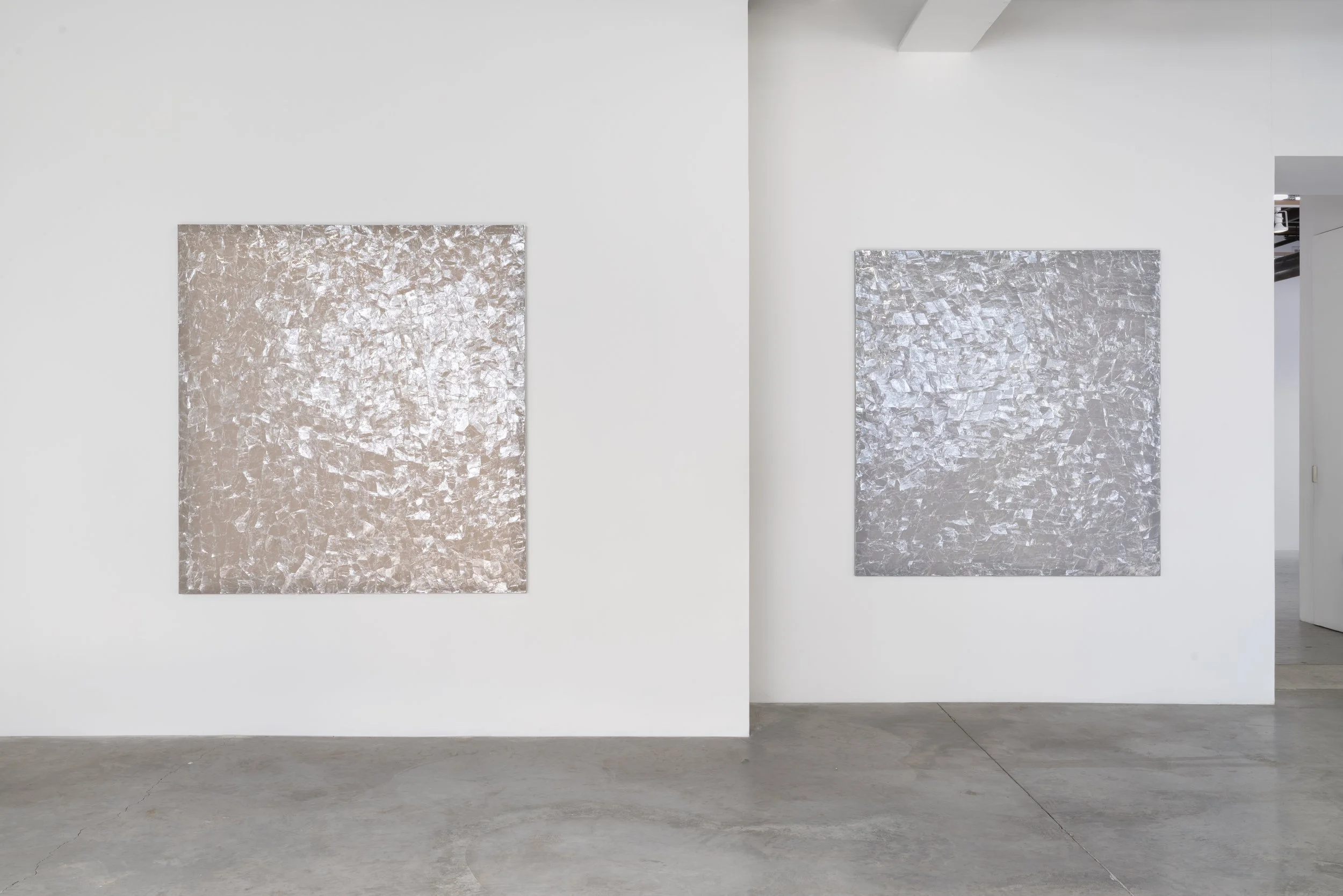
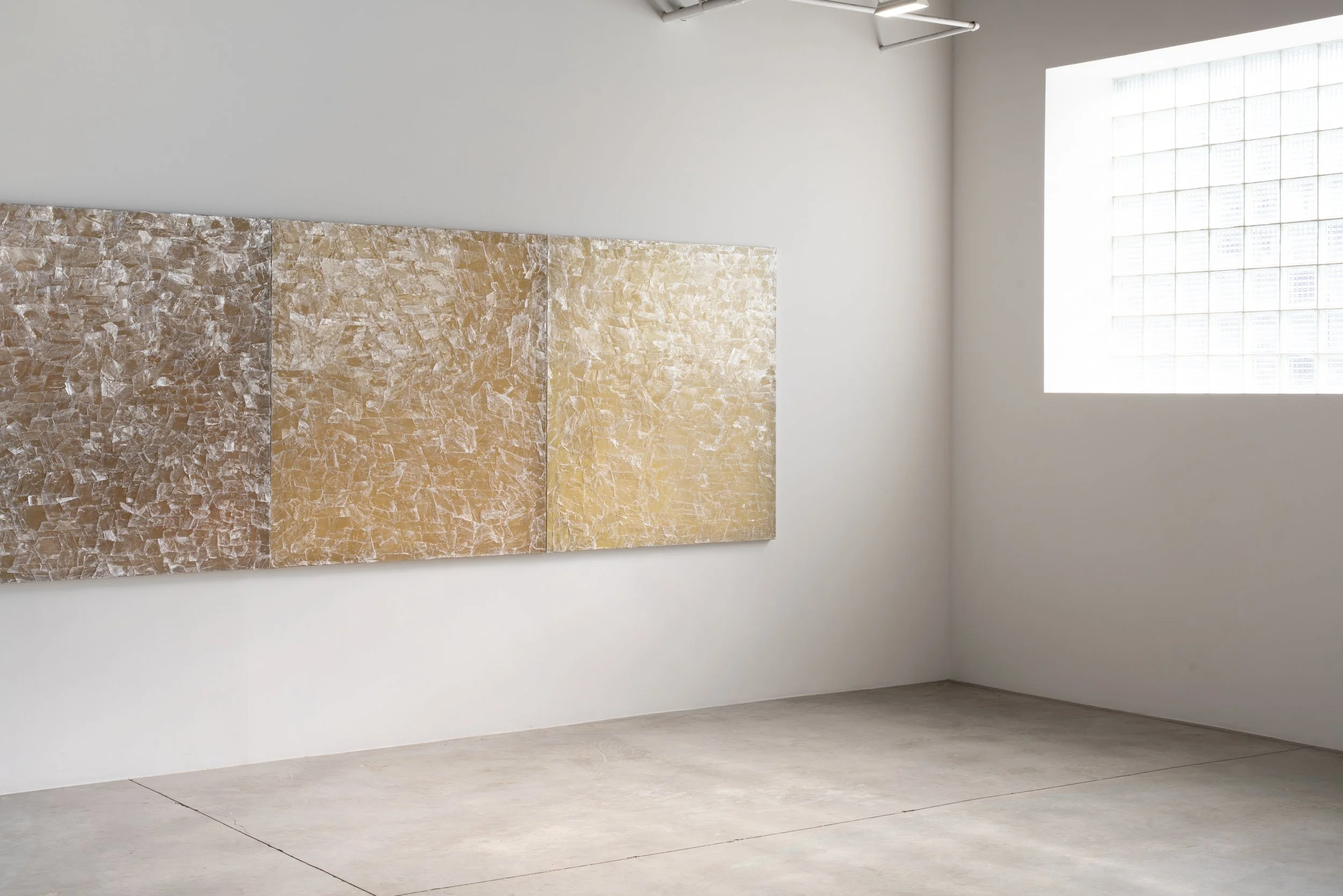
Selenite derives its name from Selene, the ancient lunar deity, whose name is itself rooted in the Greek word for light. This relationship between mineral and illumination subtly underlies a new solo presentation by Rosalind Tallmadge, in which the material's natural translucency becomes the foundation for an expansive study of surface, atmosphere, and perception. A site-specific floor installation of selenite fragments forms the exhibition's focal point, surrounded by works of layered selenite on organza silk, held within translucent frames. Together, they establish an environment of modulated light and mineral textures, where surface and depth enter into a fluid relationship as the stone gathers, diffuses, and transforms light.
Across Tallmadge's practice, there is a devotion to and tenderness for the ornamental, which she uses as a conduit for exploring light, sensation, and space. Tallmadge's interest in how light might be harnessed and spatialized, its dimensionality and motion, traces its lineage back—along one familial line—to the last century's Light and Space movement. Her works particularly share aims with the light-centric paintings of Mary Corse (b. 1945), whose thinking around abstraction, materiality, and the phenomenology of perception coalesces in shimmering canvases that remake their surroundings through the interaction of light and matter. Tallmadge extends these investigations through a radically different medium, employing the inherent optical properties of a naturally occurring mineral. Where Corse's surfaces transform in response to light and the movement of the viewer, Tallmadge's crystalline compositions similarly resist a fixed visual experience, their appearance continually altered by the conditions of their environment.
Tallmadge's selenite works, comprised of carefully layered cut and shaved stone, appear to produce light rather than simply absorb or reflect it. Emanations of color—fawn, pewter, lilac, smoke—possess a tactile quality: the sensation is of softness, a silken liquidity, which sits in tension with the hardness and density of the medium. Sensuality is abundant, tangible, and given the scale of the works, immersive. The edges where one fragment of selenite meets another are an illuminated white, as too are the stone's natural striations. Each pearlescent surface possesses a haptic quality that entwines sight and touch, its layered translucency creating an impression of depth that fluctuates between opacity and illumination. The mineral's density gives way to an unexpected delicacy, while the coruscation of light across its textured surface varies with the position of the viewer. Within Tallmadge's installation, our perception of the surrounding space begins to change. The material becomes inseparable from the conditions in which it is encountered, drawing attention to the act of perception itself.
Tallmadge assembles hymns to her medium, its materiality, its natural detail and its capacity to hold and diffuse light. Through this close attention to its properties, her work also recalls the history of crystal in decorative art. Pliny, the Roman naturalist, described crystal as forming from rainwater and snow, an account that speaks to the ancient fascination with the material's mysterious origins. Across antiquity and the Byzantine period, crystal was prized for its rarity, beauty, and perceived powers. Selenite was also historically thinned and used in place of glass in windows, producing panes that admitted diffused light while preserving a degree of opacity. The preciousness and mystique historically invested in such materials are preserved in Tallmadge's work, yet she strips away the functions traditionally associated with decorative objects. What remains is the selenite itself, its finely sliced structure recalling another material highly prized by ancient artisans, gold leaf. Removed from utility, the mineral's inherent qualities become the subject of sustained attention.
There is an imaginative eloquence to Tallmadge's use of selenite, with its vivid traces of weather and light. One might see mist settling onto a landscape. Fog clinging to the ground and rising from the water. A sky fading at dusk. A scrim of cloud over the sun. Water-carved gorges that are moist to touch, petrichor scented. Tallmadge's pool of selenite underscores how the stone naturally approximates frozen water, echoing a pond with a frosted crust, ice-inscribed patterns on its surface. Yet these glimpses of figuration never resolve into fixed images. Perspective and scale expand and contract through titles that summon atmospheric events (Aurora Australis) and outer space (Venus), as well as natural scenery (Birch). Sights and sounds and impressions are felt for a moment, then fade, transform. It is unsurprising that these works arose out of time Tallmadge spent in a new studio space in upstate New York, surrounded by the region's dense woods and dappled light. The natural world finds expression not through direct representation, but through the mutable optical qualities that define the exhibition.
Throughout Tenebrae, Tallmadge's treatment of selenite draws out the tension between the mineral's physical substance and the seemingly immaterial phenomena it evokes. Extending the perceptual investigations of Light and Space through the sensorial complexity of a natural material, Tallmadge allows the mineral's inherent properties to transform our experience of the surrounding environment. What appears at first to be a fixed surface becomes something transitory and elusive, its qualities revealed gradually through the shifting relationship between material, space, and the act of looking.
Tenebrae, a solo exhibition of new works by New York-based multimedia artist, Rosalind Tallmadge, opens at CARVALHO the evening of November 6, 2026, from 6—9, and is on view through January 9, 2027. The exhibition marks Tallmadge’s third solo with CARVALHO.
Essay by Rebecca Birrell, PhD
Rosalind Tallmadge (b. 1987, Cincinnati, Ohio) is a multi-media artist living and working between New York City and Upstate New York. Recent solo and two-person shows include Tenebrae, CARVALHO, New York (2026); Cloud Totems, David Klein Gallery (2026); Pareidolia, CARVALHO, New York (2025); Aether, CARVALHO, New York (2024); Moonlight Room, CARVALHO, New York (2022); and Unearthed, with Matt Byrd, Arden + White, New Canaan (2022). Tallmadge’s architecturally-scaled installation, Pareidolia (CARVALHO, 2025), was a site for performance in collaboration with internationally renowned contemporary ballet dancer and activist, Ingrid Silva, Principal with Dance Theatre of Harlem. Other notable exhibitions include With Eyes Opened: Cranbrook Academy of Art since 1932, Cranbrook Art Museum, Bloomfield Hills, Michigan. In 2023, Opus One commissioned an installation of five site-specific works, titled Les Elements, for the entry rotunda and Opus One’s permanent collection in Napa Valley, California. Tallmadge holds a BFA from Indiana University, Bloomington (2010), and an MFA from Cranbrook Academy of Art (2015). Her work has been acquired by international public and private collections and has been exhibited widely in New York, Brussels, Miami, Detroit, Chicago, and Seoul. Tallmadge is represented by CARVALHO, New York, and David Klein Gallery, Detroit.